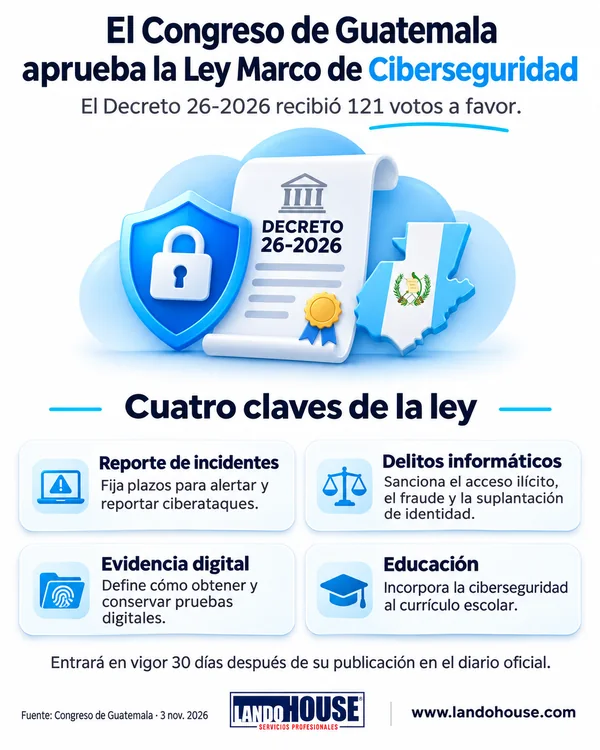
- On November 3, Congress passed the Cybersecurity Framework Law (bill 6347, Decree 26-2026) under national-urgency procedure, 121 votes to 10.
- It creates a National Cybersecurity Council, a National Cybersecurity Directorate and a national incident response center (Cric-gt).
- It defines computer crimes, sets rules for digital evidence and brings cybersecurity into the national school curriculum.
- It is not in force yet: it needs the President's sanction and takes effect 30 days after publication in the official gazette, Diario de Centro América.
Introduction
Guatemala now has, on paper, its first comprehensive cybersecurity law. Late on Tuesday, November 3, 2026, Congress fast-tracked the Cybersecurity Framework Law (Ley Marco de Ciberseguridad), enacted as Decree 26-2026, with 121 votes in favor and 10 against.
The 96-article law creates national institutions to prevent and respond to cyberattacks, defines computer crimes, sets out how digital evidence is gathered and assessed, and takes cybersecurity into the classroom. For companies and public bodies, it moves cybersecurity from "good practice" to a legal and corporate-governance matter.
The decree at a glance
We attach a copy of Decree 26-2026 (in Spanish) as passed by Congress on November 3, 2026: the text of the law plus the amendments approved on the floor. Its main points:
Copy of the text passed by Congress, pending sanction and publication. Only the version published in the Diario de Centro América is official.
- Purpose: to create the institutional framework for cybersecurity, an administrative sanctions regime, a criminal and criminal-procedure framework, and a basis for international cooperation.
- Scope: the whole country and cyberspace; the crimes reach anyone acting from abroad when the effects occur in Guatemala.
- Institutions: Conciber as the governing body, the Interior Ministry as sector lead, Diciber as the technical-operational body and Cric-gt as the national response center, alongside institutional and sector response centers.
- Incident reporting: alert to Cric-gt within 3 hours when critical infrastructure is affected and within 6 hours otherwise; full report within 72 hours, anonymized.
- Response levels: four levels, from an institutional incident to one that affects national sovereignty; at levels 3 and 4 Conciber acts as Crisis Committee.
- Obligations and sanctions: operators of essential services must apply technical and organizational measures suited to the risk and recognized standards; minor, serious and very serious violations will be defined in the regulations, favoring remediation.
- Crimes and evidence: eight computer crimes, aggravating factors for critical infrastructure, corporate fines of Q100,000 to Q300,000, rules on searches, digital preservation and international cooperation. Contract-authorized penetration testing is not a crime.
- Deadlines: in force 30 days after publication; regulations within 6 months; Cric-gt within 18 months.
Background: from bill to decree
Bill 6347 was introduced in February 2024 and received a favorable report from the National Security Affairs Committee in 2025. In April 2026, after reaching second reading, it went back to committee to refine inter-agency mechanisms; President Bernardo Arévalo warned at the time that public systems had been built without adequate protection and that "cyberspace has no geography".
Congress itself recalled the background: incidents at the Foreign Ministry (2022), the Finance Ministry (2023) and the Education Ministry (2024). In 2026, a new string of attacks pushed the issue up the agenda: the breach at Digecam (the arms-control agency), the incident on the Labor Ministry's Tu Empleo platform, and attacks on the Constitutional Court, universities and other institutions. In October the committee issued a new report (01-2026) and the bill was renamed the Cybersecurity Framework Law as its scope grew to cover administrative, criminal, procedural, preventive and educational matters.
On November 3, a privileged motion won 109 votes (107 were needed) to handle it as a national urgency in a single debate. After approving the articles and amendments, the floor voted on the final text: 121 in favor, 10 against, with 20 amendments and article substitutions included. Several lawmakers questioned the speed and asked for more time to review the amendments.
Watch the session
Congress livestreamed the 56th Additional Ordinary Session of November 3, 2026, in which Decree 26-2026 was passed. The video is on Congress's official YouTube channel (in Spanish).

What the law sets up
- National Cybersecurity Council (Conciber): chaired by the President, with the ministers of the Interior, Foreign Affairs, Defense, Finance and Communications, plus the Secretary of Strategic Intelligence. It makes the strategic decisions.
- National Cybersecurity Directorate (Diciber): the technical and operational body under the Interior Ministry: policies, strategies, protocols and coordination of prevention and response.
- Incident Response Center (Cric-gt): handles and coordinates incident response nationwide. It must be operating within 18 months after the law takes effect.
- Separate cyber defense: the Defense Ministry will have a specialized unit, distinct from civilian cybersecurity.
- Computer crimes: illegal access (4 to 6 years, according to Congress), illegal interception (5 to 8 years), attacks on data integrity (5 to 7) and on systems (5 to 8), computer forgery (2 to 6), identity theft (2 to 4, or 3 to 6 if security measures are breached), computer fraud (4 to 8) and misuse of devices (3 to 6). Penalties rise by a third in cases such as abuse by a supplier or employee, and by two thirds when critical digital infrastructure is attacked. Companies used to commit these crimes face fines of Q100,000 to Q300,000.
- Digital evidence and due process: searches of computer systems need a court order specifying which data, means, personnel and time frame; examining one device does not authorize access to other connected accounts. Before ordering a shutdown of critical financial services, a judge must first request a technical report from the central bank or the banking superintendency.
- Specialized investigation: a specialized prosecutor's office, the 24/7 Guatemala Network for international cooperation, a digital forensics unit at the national forensic institute (Inacif) and specialized courts.
- Education and participation: the Education Ministry will add cybersecurity to the national school curriculum, and a Technical Roundtable brings together the public and private sectors, academia and civil society.
What's still pending
- Passed by Congress: November 3, 2026, under national-urgency procedure (Decree 26-2026).
- Presidential sanction: the President can sign it or return it with objections (veto).
- Publication and entry into force: it takes effect 30 days after publication in the Diario de Centro América (art. 96).
- Regulations and rollout: implementing regulations within 6 months; other agencies adapt their rules within 12 months; Cric-gt operating within 18 months at most.
The specific conduct behind each administrative violation (minor, serious or very serious) and its penalties will be set in the regulations. Before the vote, the private sector, through CACIF, asked for technical amendments and warned that without them the law could face constitutional challenges, hinder accession to the Budapest Convention on cybercrime and clash with anti-money-laundering law.
What it means for Guatemala
First, it fills a gap. Until now the Criminal Code only partly covered some computer crimes, and the country had no national authority or response center with a legal mandate. The law gives a name, an owner and a procedure to something that was handled case by case.
Second, it connects Guatemala with the world. Attacks often come from abroad. The 24/7 Network and the digital-evidence rules are the basis for cooperating with other countries and service providers, and for eventually joining the Budapest Convention.
Third, it changes the boardroom conversation. An incident is no longer just a technical problem: it will sit within a criminal, procedural and administrative framework, with an authority to coordinate with. Banking, telecoms, energy, health, government and their suppliers will feel it first, but any company handling customer data should get ready.
And fourth, it doesn't solve everything. Guatemala still has no comprehensive personal data protection law, and success will depend on budget, specialized talent and clear regulations.
If you were hit by a cyberattack tomorrow, would your company know whom to call and what evidence to keep?
✅ Bonus: 6 steps to get your company ready
There's no need to wait for the regulations. These six steps are recognized good practice (ISO/IEC 27001, NIST CSF) and will leave you better placed whatever the final text says.
- Name an ownerAppoint someone with authority and access to senior management for information security: an in-house CISO or a CISO as a Service. They'll be your natural link with the new authorities.
- Identify what's criticalInventory your essential systems, data and services, and the suppliers behind them. If you serve critical sectors, expect more to be asked of you.
- Update your incident response planDefine who decides, how issues escalate and whom you notify. Use the decree's deadlines as a benchmark: alert within 3 hours if critical infrastructure is affected, 6 hours otherwise, and a full report within 72 hours.
- Be ready to preserve evidenceEnable and retain access and system logs, synchronize clocks and document the chain of custody. No evidence, no investigation.
- Review supplier contractsIT, cloud and software providers should commit to reporting incidents, cooperating with investigations and handing over logs when you need them.
- Train and rehearseTrain staff on phishing, impersonation and fraud, and run at least one incident drill a year with senior management.
Pro tip
Read the decree once it's published, but don't read it alone. Pair the legal review with a technical one: many obligations (reporting, preserving evidence, cooperating) can only be met if the controls already exist. This newsletter is for information only and is not legal advice.
Frequently asked questions
Is Guatemala's Cybersecurity Framework Law in force?
Not yet. Congress passed it on November 3, 2026; it still needs the President's sanction and publication in the Diario de Centro América. It takes effect 30 days after publication.
How quickly must an incident be reported?
Sector and institutional response centers must alert the Cric-gt of significant incidents within 3 hours when critical infrastructure is affected and within 6 hours otherwise, and send a full report within 72 hours.
What is the law's number?
It is Decree 26-2026 of the Congress of Guatemala, which comes from bill 6347. It was passed under national-urgency procedure, 121 votes to 10.
Which institutions does it create?
The National Cybersecurity Council (Conciber), the National Cybersecurity Directorate (Diciber) under the Interior Ministry and the Cybersecurity Incident Response Center of Guatemala (Cric-gt), plus a specialized prosecutor's office, the 24/7 Guatemala Network and a forensics unit at Inacif.
Which computer crimes does it punish?
Among others, illegal interception of data, attacks on data and system integrity, identity theft and misuse of devices, with prison terms that rise when critical infrastructure is affected.
Does it affect private companies?
Yes. The crimes apply to anyone. In addition, operators of essential services and anyone running systems whose disruption could compromise essential services or critical infrastructure fall under an administrative sanctions regime: they must apply technical and organizational measures suited to the risk and meet recognized standards or certifications. Organizations already covered by sector-specific cybersecurity rules are excluded.
Is it a personal data protection law?
No. Guatemala still has no comprehensive personal data protection law; this one focuses on cybersecurity, cybercrime and digital evidence.
Is your organization ready for the new law?
We help you assess your readiness, name an owner and put in place the controls the law will take for granted: governance, incident response, evidence and continuity.
Sources and fact-checking
LandoHOUSE editorial newsletter based on Soy502 and cross-checked with (sources in Spanish):
- Congreso de la República — Normativa previene y persigue los delitos digitales (03/11/2026)
- Congreso de la República (YouTube) — 56.ª Sesión Ordinaria Adicional de la X Legislatura, 03/11/2026 (video)
- Decreto Número 26-2026, Ley Marco de Ciberseguridad — copia del texto aprobado por el Congreso con sus enmiendas (PDF, 59 págs.)
- Soy502 — Congreso busca aprobar de urgencia nacional la Ley de Ciberseguridad (03/11/2026)
- Prensa Libre — Congreso aprueba de urgencia nacional la Ley de Ciberseguridad con 121 votos (03/11/2026)
- La Hora — Congreso da luz verde y aprueba de urgencia nacional Ley Marco de Ciberseguridad (03/11/2026)
- República — Diputados aprueban de urgencia nacional la Ley de Ciberseguridad (03/11/2026)
- Emisoras Unidas — Ley de Ciberseguridad previene y combate delitos cibernéticos (03/11/2026)
- CACIF — Llamado a aprobar la Ley Marco de Ciberseguridad con enmiendas técnicas (03/11/2026)
- AGN — Gobierno espera que el Congreso apruebe ley marco contra ciberataques (27/04/2026)
- La Hora — Dictamen de la Ley de Ciberseguridad fortalece la Dirección Nacional (04/10/2026)
- Congreso de la República — Dictamen favorable de la Comisión de Asuntos de Seguridad Nacional, iniciativa 6347 (PDF)
This newsletter was checked against the copy of the approved Decree 26-2026, including its amendments (in Spanish). Only the version published in the Diario de Centro América is official, and article numbers may shift once amendments are merged. For information only; not legal advice.